


A Parent's Guide to Self Regulation in Children

When we talk about self-regulation, we're talking about a child's ability to manage their emotions, actions, and attention. It's so much more than just 'good behaviour'. It's the foundational skill that helps them navigate their world, whether that's handling frustration with a tricky puzzle or staying focused during story time.
What Self-Regulation Means for Your Child
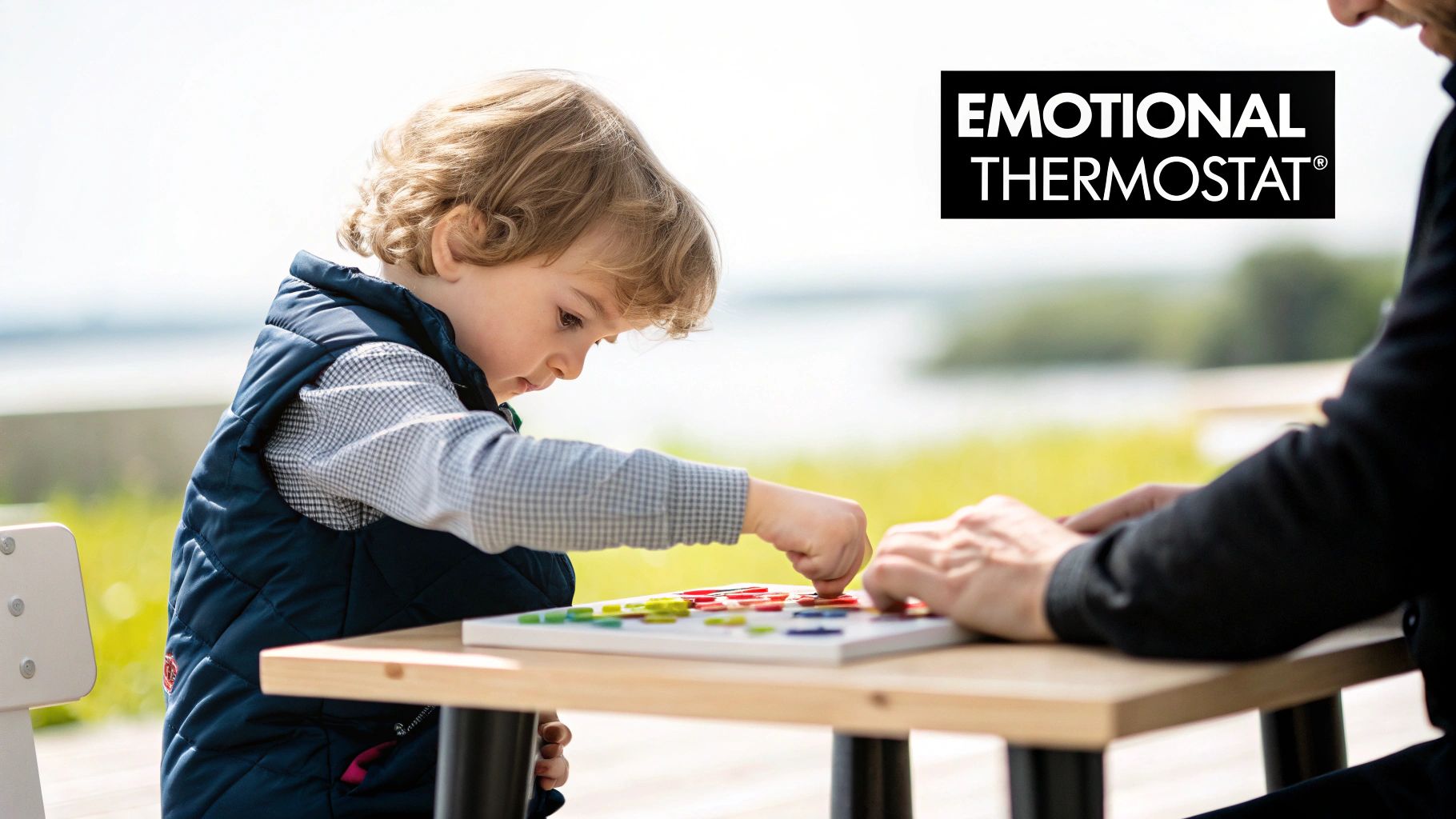
Think of self-regulation as your child’s internal control centre. It’s the powerful, developing ability to manage big feelings, control impulses, and maintain focus on a task. It's what helps a child wait their turn for the slide, calm themselves down after a disappointment, or listen to instructions in a bustling classroom.
This isn't a skill children are born with; it's a journey of learning and development that happens over time with our support.
A great way to picture it is to imagine your child is learning to be their own emotional thermostat. They gradually learn how to turn the dial down when they feel overwhelmed by frustration, or turn it up to maintain concentration when distractions are high. This skill is far more than just surface-level behaviour management—it's about building the internal architecture for lifelong resilience. For example, building with Magnatiles can help children develop patience and cognitive regulation as they work through complex designs.
The Three Pillars of Self-Regulation
To really get a grip on this complex skill, it helps to break it down into its core components. Self-regulation is built on three key pillars that work together, influencing everything from social interactions to academic success.
Let's look at how these three pillars work in practice.
| Type of Regulation | What It Means | Example in Daily Life |
|---|---|---|
| Emotional Regulation | This is all about managing feelings—recognising emotions, understanding their triggers, and responding in a healthy way. | Instead of hitting, a child learns to say, "I'm feeling angry because you took my toy." |
| Behavioural Regulation | This refers to controlling actions and impulses. It's the skill that stops a child from snatching a toy or helps them follow rules. | A child waits for their turn to speak in class, even when they're bursting with an idea. |
| Cognitive Regulation | This is about managing thoughts and attention. It includes skills like planning, problem-solving, and staying focused on a goal. | A child concentrates on finishing their drawing, even when a sibling is playing loudly nearby. |
As you can see, all three are interconnected and essential for navigating daily challenges.
The ability to self-regulate is a powerful predictor of future success. Research from the Longitudinal Study of Australian Children found that about 15% of infants with high self-regulation showed better behavioural outcomes by age 4-5, with up to 30% lower rates of aggression and hyperactivity.
Why Self-Regulation Is So Important
Mastering self-regulation is a cornerstone of childhood development, impacting nearly every part of a child's life. When children can manage their inner world, they are far better equipped to navigate the outer world.
Understanding this skill is especially important when considering challenges like sensory processing difficulties, which can make it much harder for a child to regulate. To learn more about this connection, you might find our guide on what is sensory processing disorder helpful.
Self-regulation is the brain-body response to stress. It's the ability to remain calm and focused when experiencing stressors, whether they are physical, emotional, or cognitive.
When we support the development of self-regulation, we are helping our children build a toolkit for life. This foundation helps them make friends, thrive at school, and develop the emotional intelligence they need for a happy, well-adjusted future. Even simple toys like Bluey merchandise can support this by encouraging imaginative play where children can act out and process different social scenarios.
Recognising the Signs of a Struggling Nervous System
Before you can help a child with self-regulation, you need to become a bit of a compassionate detective. This means looking past surface-level behaviours—what we might label as ‘naughty’ or ‘defiant’—and starting to read the signals their nervous system is sending. These actions aren't usually a conscious choice; they're often a cry for help from a system that's completely overwhelmed.
When a child’s internal "thermostat" is on the fritz, they can swing between two very different states of dysregulation. Learning to spot these states is the key to shifting your own response from punishment to the co-regulation and support they desperately need.
The Revved-Up State: Hyper-Arousal
When a child is in a state of hyper-arousal, their nervous system is in overdrive. Think of it like their internal engine is redlining, but they can't find the brakes. This is the classic "fight or flight" response kicking in, often when there's no real danger in sight.
This state can be loud, chaotic, and very easily misinterpreted as just "acting out." Picture a child at a noisy birthday party who suddenly starts running in circles, shouting, and seems incapable of listening to a single word. Their system is completely overloaded by the sights and sounds, and this is how they’re trying to cope.
Common signs of hyper-arousal include:
- Excessive Movement: Constant fidgeting, an inability to sit still, running, or jumping when it's not appropriate.
- Impulsivity: Acting without thinking, like snatching toys or blurting things out.
- Loud Vocalisations: Shouting, screaming, or making constant noise.
- Emotional Volatility: Flying off the handle over small things, showing quick frustration or full-blown meltdowns.
- Aggression: Hitting, pushing, or even biting as a physical outlet for those huge, overwhelming feelings.
In these moments, a child isn’t trying to be difficult. Their brain and body are flooded with stress hormones, and they're frantically searching for a way back to a feeling of safety and calm.
The Checked-Out State: Hypo-Arousal
On the other end of the spectrum is hypo-arousal, where the nervous system essentially shuts down to conserve energy. This is the "freeze" response. It can be much harder to spot because it's quiet and passive. The child might seem withdrawn, sluggish, or totally disconnected from what’s going on around them.
Imagine a child in a busy supermarket who goes limp in the trolley, stares blankly into space, and stops responding when you talk to them. They haven’t suddenly become defiant; their system is so overwhelmed that it’s flipped into a low-power mode to survive the experience.
A child in hypo-arousal isn't ignoring you; they are in a state of self-preservation. Their brain is working so hard to manage internal chaos that there's little energy left for engaging with the outside world.
You might notice the following signs:
- Lethargy: Seeming unusually tired, sluggish, or having "heavy" limbs.
- Withdrawal: Avoiding eye contact, pulling away from social interaction.
- Passivity: Being unusually compliant or showing very little emotional reaction to anything.
- Difficulty Processing: Appearing "zoned out" or taking a very long time to respond to questions or instructions.
- Appearing "Floppy": A noticeable decrease in their muscle tone.
How Sensory Tools Can Help Bridge the Gap
Recognising these states is the first, crucial step. Responding with the right kind of support is the next. This is where sensory toys in Australia can make a world of difference, providing the targeted input a struggling nervous system needs to find its way back to a balanced, regulated state.
For a child who is revved up and overwhelmed by noise, a pair of noise-cancelling earmuffs for kids can instantly turn down the volume of the world, giving their system a chance to breathe and calm down.
Likewise, for a child who has checked out, the deep, grounding pressure from weighted animal toys can provide the organising input needed to help them feel present and secure in their body again. These tools aren't just toys; they are essential aids for navigating a world that can often feel far too intense.
How Children Learn to Regulate from Toddlers to Tweens
Learning to self-regulate isn't like flipping a switch. It’s a skill that builds slowly, year after year, and the journey is rarely a straight line. Expect plenty of two-steps-forward, one-step-back moments.
Understanding this developmental timeline helps you give the right kind of support when it’s needed most. It also helps you see that the bumps along the road are a completely normal and expected part of your child learning one of life's most essential skills.
The cycle of dysregulation often follows a predictable pattern: a trigger sparks a reaction, which can escalate into a meltdown before eventually leading to recovery.
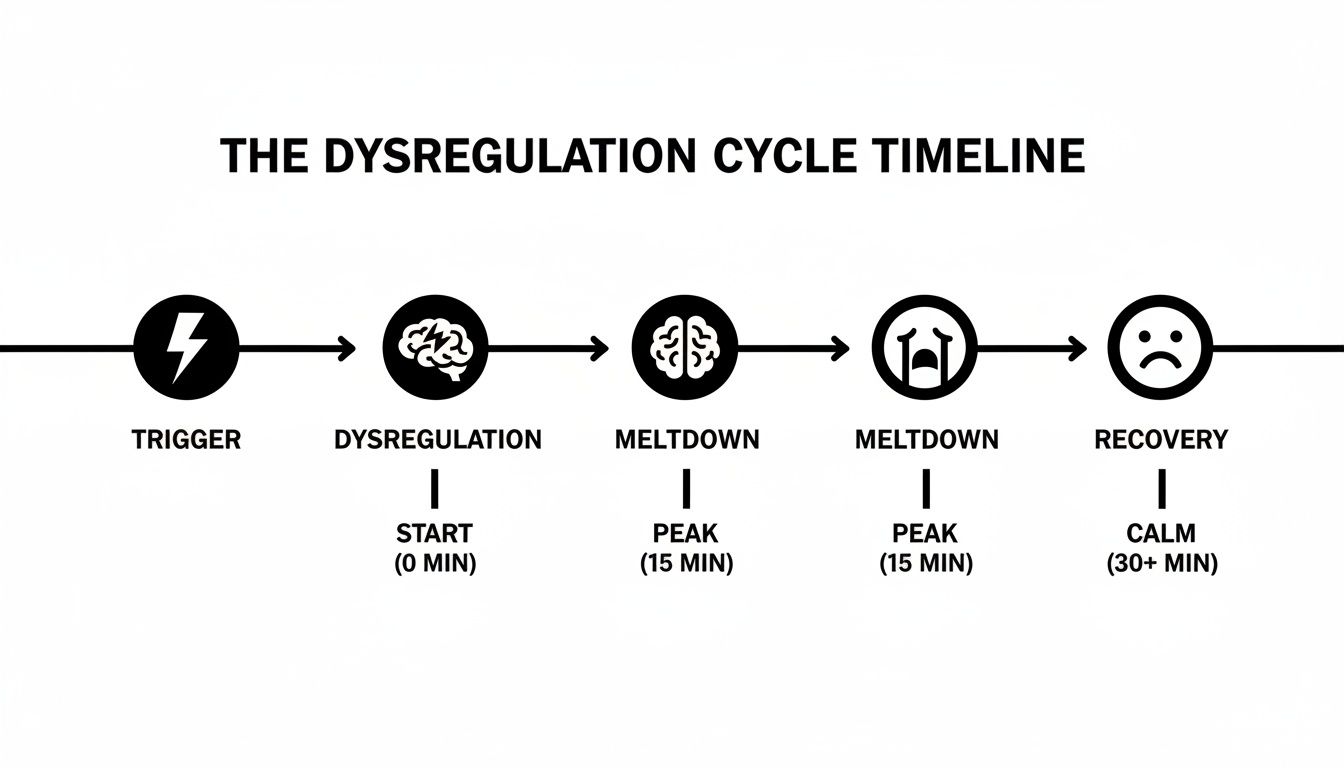
This visual shows just how quickly an internal or external trigger can spiral. It really drives home the importance of stepping in early to help a child find their calm before they reach a full-blown meltdown.
Toddlers (Ages 1-3): The Age of Co-Regulation
For toddlers, self-regulation is almost entirely about co-regulation. Think of yourself as their emotional anchor. You lend them your calm when their big feelings become too much to handle, because they simply haven't built the internal wiring to manage that intensity on their own yet.
When a toddler has a tantrum because they can't have a biscuit, they aren't trying to manipulate you. Their little brain is just flooded with frustration, and they need a calm, steady adult to help them ride it out. Your soothing voice, a gentle hug, or even just sitting quietly with them teaches their nervous system what calm actually feels like.
Introducing structured quiet time can be a game-changer for our littlest ones. You might want to explore some calming quiet time activities for toddlers to help them build these foundational skills from the very beginning.
Preschoolers (Ages 3-5): Emerging Impulse Control
Once kids hit the preschool years, you’ll start to see the first glimmers of them managing things internally. This is when they might actually wait (for a few seconds!) for their turn, use simple words to name their feelings, or follow a two-step instruction.
But don't be fooled—their ability to regulate is still very fragile. A long day, being hungry, or too much excitement can easily drain their resources and lead straight to a meltdown. In fact, the Australian SPROUTS study found that while 70-80% of preschoolers get better at this, about 20-25% show very little improvement as they head into primary school. The ones who do improve get an immediate 28% boost in school readiness scores, which shows just how critical this period is.
During the preschool years, children are like emotional apprentices. They are watching how you handle your own stress and borrowing your strategies to build their own toolkit.
Simple tools can make a huge difference at this age. For example, educational toys that require a bit of patience and turn-taking, like those in our Numberblocks collection, are a fantastic way to practise these new skills in a fun, low-pressure environment.
School-Aged Children (Ages 6-9): Tackling Complexity
By the time children reach primary school, the self-regulation demands ramp up significantly. Suddenly, they’re expected to navigate complex playground dynamics, focus during longer lessons, and start planning their own work.
They begin to internalise rules and can think more logically about consequences. This is when you'll see them using more advanced strategies, like taking a deep breath when they feel angry or walking away from something that's frustrating them.
Even with this growth, they still need a lot of adult guidance. Common challenges at this age often look like:
- Difficulty handling the disappointment of losing a game.
- Struggling to start homework without constant reminders.
- Overreacting to disagreements with friends or perceived slights.
Tweens (Ages 10-12): The Pre-Teen Brain
The tween years throw another layer of complexity into the mix as the brain starts a massive pre-adolescent reorganisation. Their executive functions—things like planning, staying organised, and thinking flexibly—become much more sophisticated.
At the same time, social pressures ramp up, and their emotional responses can become a lot more dramatic. A tween might be able to create a detailed plan for a school project but still have an epic meltdown because a sleepover got cancelled. The key is to support them with empathy while still holding firm, clear expectations. This is the stage where they really start to consolidate all the co-regulation you’ve offered over the years, learning to apply those skills more and more independently.
Practical Ways to Build Self-Regulation Skills at Home
Helping a child build their self-regulation skills isn't about grand gestures or complex programs. The real magic happens in the small, consistent moments of everyday life, with you as their emotional coach and safe harbour.
Your role is to essentially lend them your calm when they're lost in chaos. This is what experts call co-regulation. When your child is caught in an emotional storm, you become their anchor, gently guiding them back to a place of safety. Over time, they begin to internalise this process and learn how to find that calm within themselves.
This supportive environment is everything. In fact, a key Australian study found that a staggering 62% of a child's self-regulation growth was linked to consistent parental support and a stable home life. Children in these nurturing homes showed 45% faster gains in skills like inhibitory control, proving just how powerful your daily presence is.
Establish Predictable Routines
Kids thrive on knowing what to expect. When their day has a familiar rhythm, the world feels safer and far less overwhelming, which frees up their mental energy to manage emotions instead of worrying about what’s next.
Simple, predictable routines for mornings, meals, and bedtime create a reliable structure that helps a child’s nervous system stay settled. This doesn’t mean your schedule has to be military-grade rigid, but a dependable flow is incredibly grounding.
Visual aids are a fantastic way to make routines more concrete. A simple chart with pictures or words can empower your child to follow the steps independently. You can find more tips for this in our guide on creating an effective kids' routine chart.
Use "First-Then" Language
"First-then" is a brilliantly simple yet powerful tool for navigating those tricky transitions. It frames expectations clearly by showing that a less-preferred activity is simply the path to something they want to do.
So, instead of, "You can't play until you tidy your room," you’d reframe it as, "First we pack away the blocks, then we can go outside."
This small linguistic tweak works wonders. It:
- Reduces anxiety by making the sequence of events clear.
- Builds cooperation by focusing on the positive outcome.
- Teaches delayed gratification, which is at the very heart of self-regulation.
Create a Dedicated Calming Corner
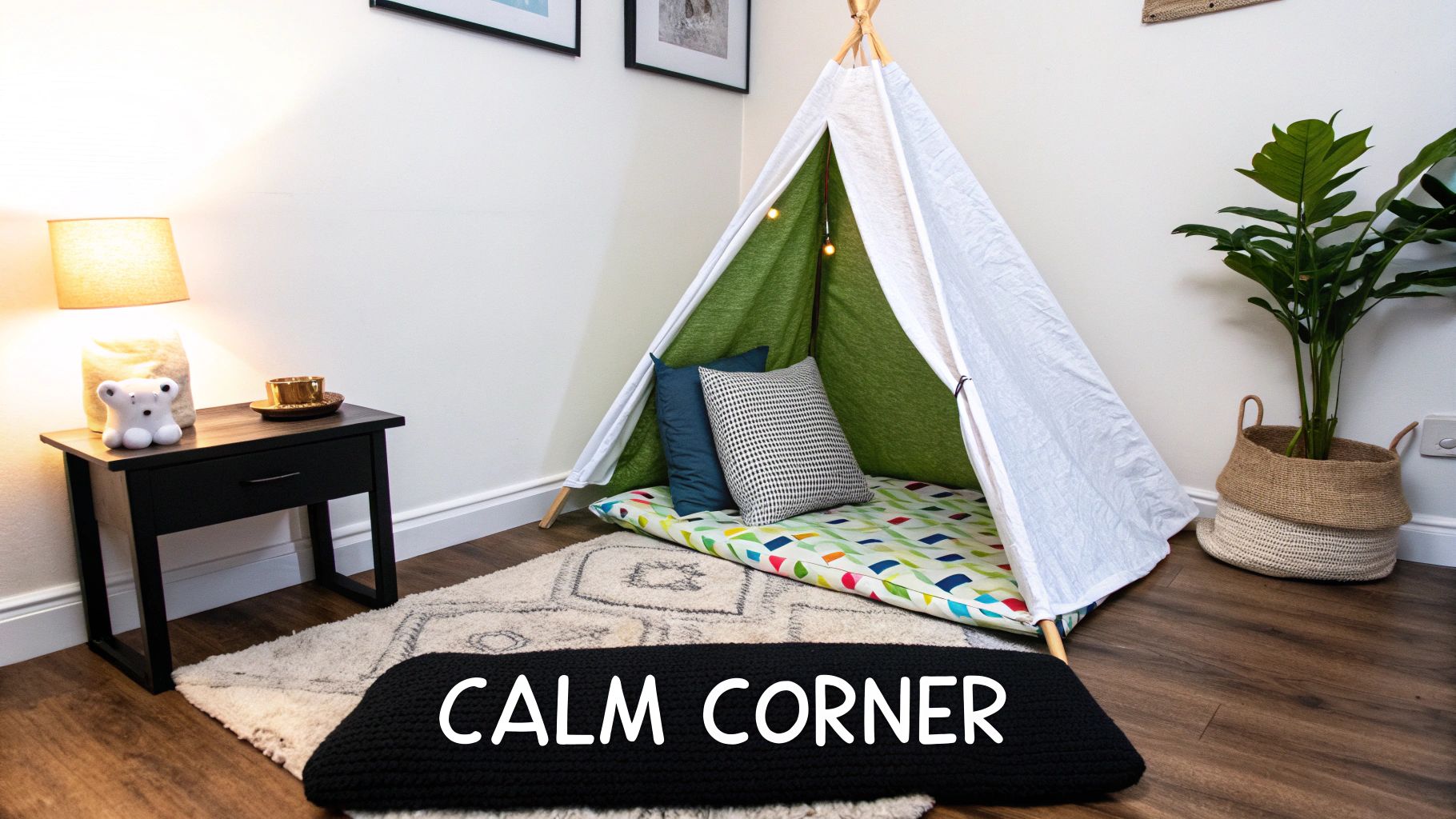
Every child deserves a safe haven—a special spot they can retreat to when emotions feel too big to handle. This isn't a "time-out" corner for punishment; it's a positive space for self-regulation. It’s a place that communicates, "It’s okay to feel this way, and here is a safe place to work through it."
This special area should be quiet, comfy, and stocked with tools that help soothe the nervous system. The goal is to create a sensory-friendly escape that practically invites calm. You can easily furnish this spot with items like a soft play mat and a comfy sensory tent.
A calming corner empowers a child by giving them a physical place to practise emotional management. It teaches them to recognise their own need for a break and actively seek out strategies that help them feel better.
You can set up your calming corner with a few thoughtful items. Consider including things like a mesmerising bubble tube for gentle visual input that can quiet a busy mind, or one of the many weighted blankets to provide deep, organising pressure to an overwhelmed nervous system. Many families find natural techniques to calm anxiety like mindfulness and grounding exercises are brilliant additions, too.
By weaving these supportive tools and strategies into your home, you're building a powerful foundation for your child's emotional wellbeing, giving them the skills they need to navigate life's ups and downs with resilience.
Using Sensory Tools to Support a Calm Nervous System
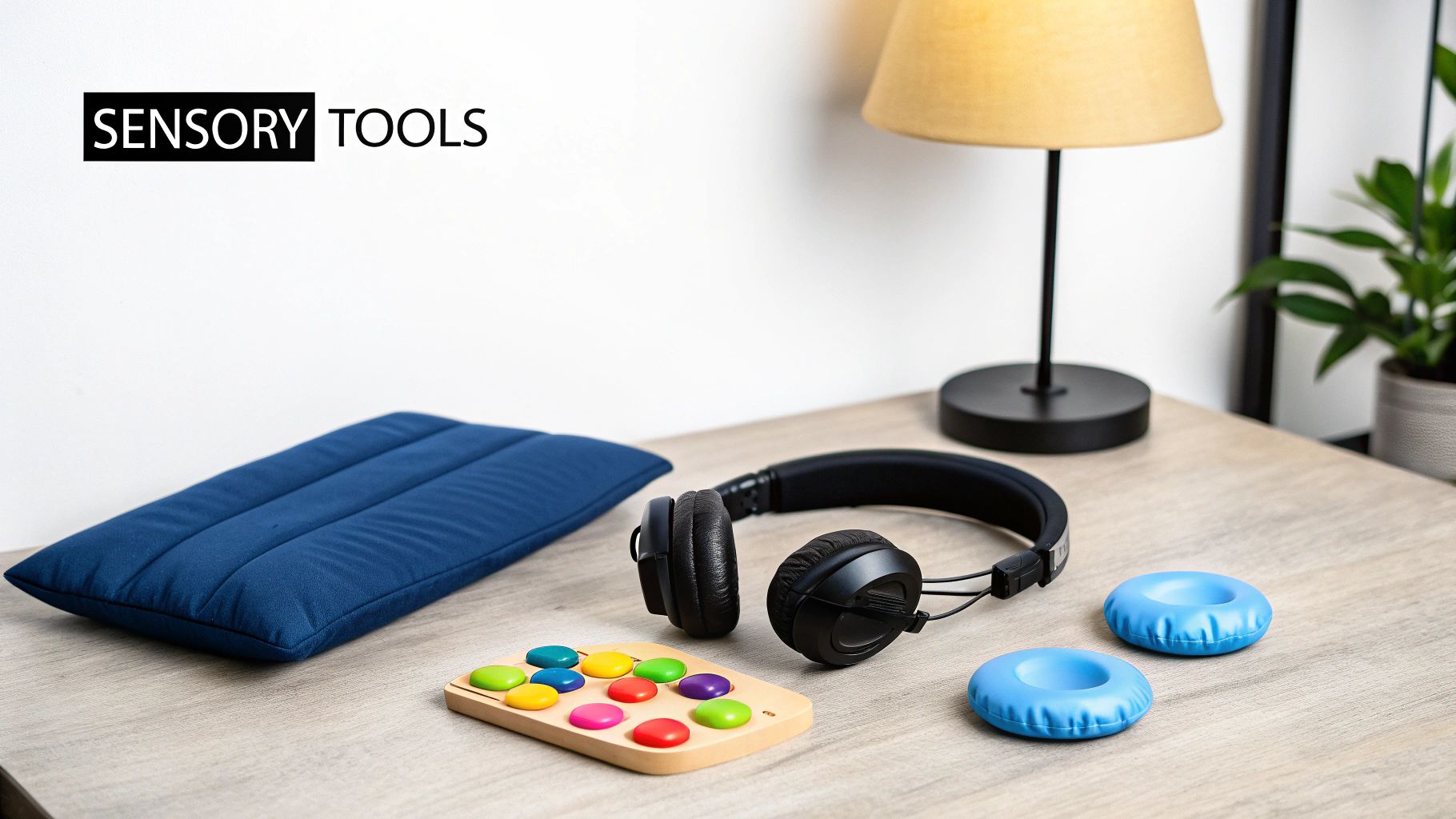
Sensory tools are so much more than just interesting toys. Think of them as a direct line of communication to your child's nervous system. They offer the specific sensory input a child needs to feel grounded, focused, or even energised, helping them find their way back from a state of overwhelm to a place of calm and control.
When you understand why these tools work, you shift from simply buying things you hope will help to becoming an informed problem-solver. Instead of adding another item to the toy box, you can start choosing supports that directly address your child's underlying sensory needs. This targeted approach is the secret to building a truly effective toolkit for self regulation in children.
Providing Deep Pressure for a Grounded Body
One of the most powerful and organising types of sensory input is deep pressure. This activates the proprioceptive system—the network of receptors in our muscles and joints that tells our brain where our body is in space. For a child who feels anxious or overwhelmed, deep pressure feels like a firm, reassuring hug for their entire nervous system.
This kind of input has a wonderfully grounding effect. It can help calm a child who is all revved up and bouncing off the walls (hyper-aroused) or bring a gentle awareness back to a child who seems to have zoned out (hypo-aroused).
Some great tools for providing this input include:
- Weighted Blankets: Offering consistent, gentle pressure, a good weighted blanket like the Neptune Blanket can encourage relaxation and even improve sleep.
- Sensory Swings: The combination of a snug fit and gentle motion in a sensory swing provides both deep pressure and calming vestibular input.
- Weighted Toys: Cuddling one of the many available weighted animal toys gives targeted pressure that is both comforting and portable enough to take anywhere.
Soothing the Senses with Visual and Auditory Tools
For many kids, the world can be an incredibly loud and visually busy place. Sensory tools that help manage this input can create an instant sense of peace, giving a child’s frazzled nervous system a much-needed break.
When it comes to visual input, something like a mesmerising Jellyfish Lamp offers slow, predictable movement that can capture a child’s attention and quieten a busy mind. This gentle focus is a surprisingly effective way to guide a child out of an escalating emotional state.
When a child's nervous system is overwhelmed, the right sensory tool acts as an anchor. It gives their brain something predictable and calming to focus on, interrupting the cycle of stress and providing a path back to regulation.
To manage auditory overload, noise cancelling earmuffs for kids can be an absolute game-changer. They effectively turn down the volume of a chaotic environment, which can reduce sensory overwhelm and help prevent meltdowns before they even start.
Engaging the Hands with Tactile Feedback
For a lot of children, the need to touch, squeeze, and manipulate objects is a crucial part of staying regulated. Tactile fidgets provide a safe and appropriate outlet for that restless energy, which can significantly improve focus and reduce anxious feelings.
It’s a common misconception that these tools are distractions—in reality, they are focus aids. The repetitive motion of a fidget can occupy the part of the brain that might otherwise get distracted, freeing up mental resources for listening or learning.
Effective tactile tools come in all shapes and sizes, from quiet, discreet options perfect for the classroom to more robust items for home.
- Kaiko Fidgets: Known for their durable metal construction, these fidgets offer a smooth, repetitive motion that many find incredibly calming.
- Needohs: The squishy, satisfying texture of a Needoh provides fantastic stress-relieving feedback for busy hands.
Figuring out what works best for your child can be a process of discovery. The key is to match the tool to the specific sensory need you're seeing.
Choosing the Right Sensory Tool for Your Child's Needs
To help you get started, here’s a quick guide to connect common challenges with sensory tools that might help.
| If Your Child Struggles With... | Sensory Need | Helpful Tools to Try |
|---|---|---|
| Feeling anxious or overwhelmed | Deep Pressure, Calming Input | Weighted blankets, sensory swings, weighted toys, gentle squeezes. |
| Restlessness and an inability to sit still | Proprioceptive & Tactile Input | Fidget tools (Kaiko, Needohs), wobble cushions, resistance bands. |
| Being easily distracted by noise | Auditory Filtering | Noise-cancelling earmuffs or headphones. |
| Difficulty winding down for sleep | Calming Visual & Deep Pressure | Jellyfish lamp, weighted blanket, slow rocking in a swing. |
| Chewing on non-food items (clothes, pencils) | Oral Motor Input | Chewable jewellery or designated "chewies." |
| Appearing "checked out" or lethargic | Alerting Sensory Input | Bouncing on a therapy ball, upbeat music, tactile fidgets with varied textures. |
Remember, this is just a starting point. Every child is unique, so observe what seems to calm or alert them and build your toolkit from there.
By exploring a variety of sensory experiences, you can learn which tools best meet your child’s individual needs. For a deeper dive, check out our comprehensive guide on sensory toys in Australia. Choosing the right support is a powerful and loving step on your child's self-regulation journey.
When to Seek Professional Support for Regulation Challenges
While the strategies in this guide can make a world of difference, some children need more specialised support to build their self-regulation skills. And that’s completely okay. Knowing when to reach out is a powerful, proactive step in getting your child the right tools for their unique wiring.
Always trust your gut. You know your child better than anyone. If you feel like you’ve tried everything and the challenges aren't getting better—or are even getting worse—it might be time to chat with a professional.
Key Signs It Might Be Time to Get Help
It can be tough to tell the difference between a passing phase and a sign of a deeper struggle. Here are a few red flags that suggest it’s a good idea to seek an expert opinion:
- Frequent and Intense Meltdowns: We’re not talking about the odd toddler tantrum. This is about explosive, long-lasting meltdowns that happen regularly and consistently throw family life into chaos.
- Persistent Social Difficulties: Your child constantly struggles to make or keep friends, seems to misread social cues, or often finds themselves in conflict in the schoolyard.
- Extreme Sensory Sensitivities: Their reactions to everyday sights, sounds, or textures are so severe they get in the way of normal activities, like going to the supermarket, attending birthday parties, or wearing certain clothes.
- Safety Concerns: Their impulsivity or aggression puts themselves or others at risk of getting hurt.
- Significant School Disruption: You’re getting frequent calls from school about your child's focus, behaviour, or emotional outbursts in the sensory classroom.
Reaching out for help isn't a sign of failure—it's a sign of great advocacy. It means you’re committed to understanding your child and finding the best way forward.
Who to Talk To and What to Expect
If any of those signs ring true, a great first step is usually your GP or paediatrician. They can offer a referral to a specialist like a child psychologist or, very commonly, an Occupational Therapist (OT). OTs are brilliant at figuring out how a child’s sensory system and regulation skills are affecting their day-to-day life.
So, what happens next? An initial assessment usually involves a chat with you about your concerns, some observation of your child at play, and maybe a few standardised checklists. The whole point is to build a complete picture of your child’s strengths and challenges.
From there, the professional will create a support plan just for them. This might involve one-on-one therapy sessions, specific strategies to try at home, or recommendations for creating supportive sensory spaces. Taking this step is all about arming yourself with knowledge and a clear path forward.
Your Self-Regulation Questions Answered
When you're navigating the world of self-regulation with children, questions are bound to pop up. It’s a complex journey, after all! Here are some of the things parents and teachers often ask, with answers to guide you along the way.
Is it possible to have too many sensory toys?
It's a great question, and the short answer is yes. It's easy to think more is better, but what we're really aiming for is effective, not more. A toy box overflowing with options can be just as overwhelming as no options at all.
Think of it as creating a personalised toolkit rather than a massive collection. Take some time to observe which specific tools genuinely help your child feel centred and focused. You might find that rotating a small handful of high-quality items, like some durable Kaiko Fidgets or a favourite weighted toy, is far more effective than presenting a huge array of choices.
What’s the right age for a child to self-regulate?
This is a bit like asking when a child should be able to run a marathon. There's no magic age. Self-regulation is a skill that develops and matures over a lifetime, beginning with co-regulation in infancy and continuing right through the teenage years and beyond.
A toddler's version of self-regulation (maybe taking a deep breath with you) looks completely different from a seven-year-old's (perhaps choosing to walk away from a frustrating game). Instead of watching the calendar, focus on providing the right support for their current developmental stage and celebrate every little win.
What's the difference between a tantrum and a meltdown?
Understanding this difference is a game-changer for how you respond. They might look similar on the surface, but they come from very different places internally.
A tantrum is usually goal-driven. The child wants something—a toy, to stay at the park, to avoid bedtime—and their big emotions are a strategy to get it. When the goal is met or they realise it's not going to happen, the tantrum typically stops.
A meltdown is a whole different beast. It’s an involuntary, neurological response to being completely overwhelmed by sensory or emotional input. The child isn't trying to get something; their "fight or flight" system has taken over, and they've lost control. The priority here is safety and creating a calm space. Discipline won't work. Instead, focus on helping their system reset after the storm, perhaps with a gentle rocking motion in a sensory swing or the deep pressure from a Neptune Blanket.
At Sensory Poodle, we're passionate about getting the right tools into the hands of families and educators across Australia to support every child's unique developmental journey.
Explore our full collection of sensory aids and calming tools at SensoryPoodle.com.au