


A Guide to the Child's Night Light Projector for Calmer Nights

Staring down another difficult bedtime is just plain exhausting. For parents of neurodiverse children, that nightly routine can often be filled with anxiety, resistance, and a feeling that you've tried everything. This is where a child's night light projector can make a world of difference. It's a gentle yet surprisingly powerful tool that can turn a bedroom into a calming sensory space, transforming the dread of bedtime into a peaceful ritual.
Transforming Bedtime Battles into Peaceful Nights
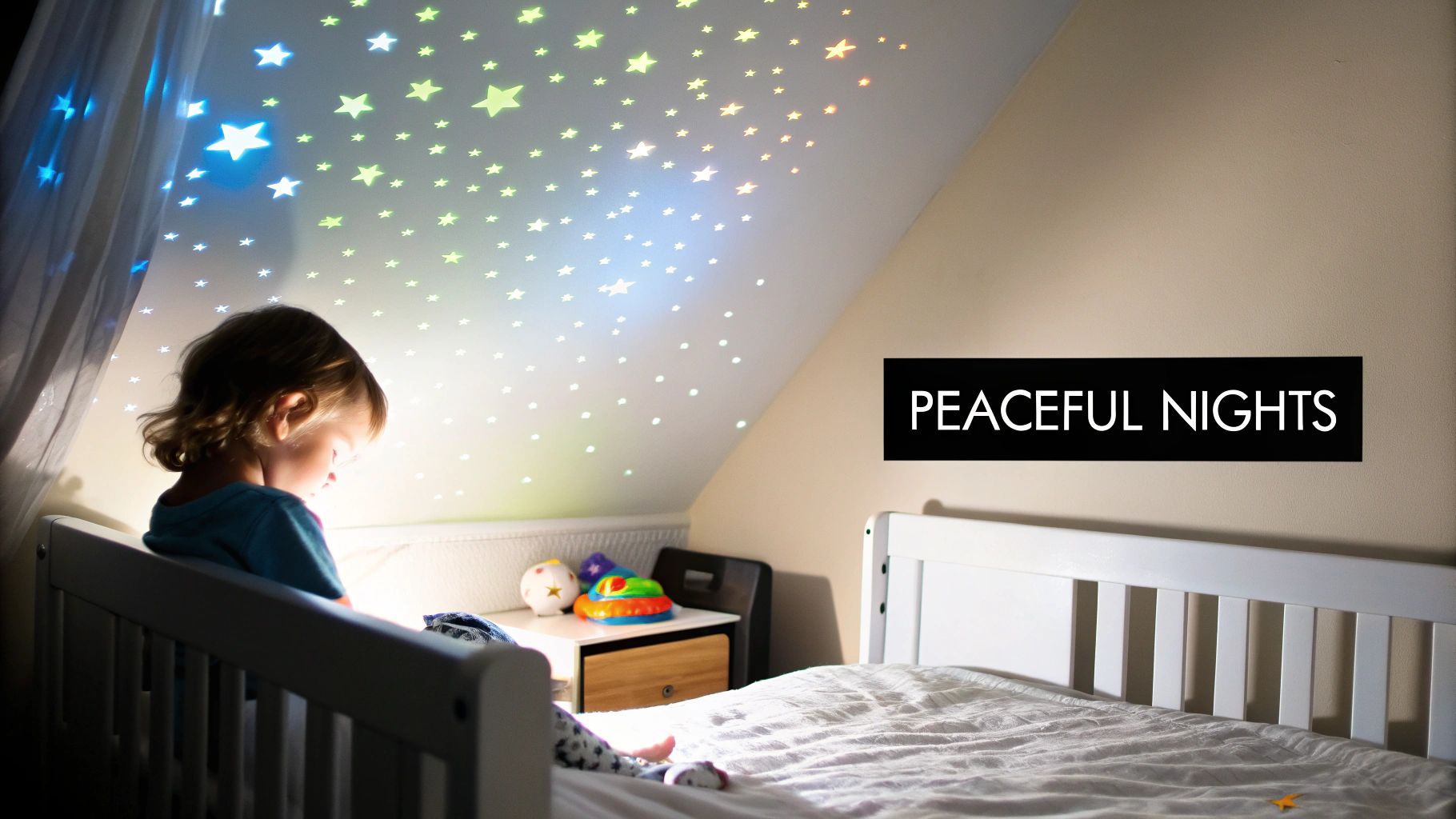
This is so much more than just a light. Think of it as an essential sensory tool. By casting mesmerising patterns onto the walls and ceiling—like a gentle starry sky or soft ocean waves—it creates an immersive and predictable environment that helps soothe an anxious mind.
This steady visual input gives your child something calming to focus on, encouraging self-regulation. Instead of their mind racing with overwhelming thoughts or fears of the dark, their attention is softly drawn to the slow, predictable movement above them. It turns a stressful moment into one of peace.
The Power of a Predictable Bedtime Ritual
As many of us know, a consistent bedtime routine is a total game-changer. A child's night light projector can become the anchor of this ritual, sending a clear signal to the brain and body that it’s time to wind down. The familiar glow and patterns offer a deep sense of security and control, which is incredibly comforting for children who thrive on routine. It’s a simple addition that can bring so much peace back to your family's evenings.
Here in Australia, the need for effective sensory toys australia is huge. Sleep challenges affect a staggering 50-80% of children on the autism spectrum, making innovative sleeping aids absolutely vital for families navigating neurodiversity. In fact, a 2024 trial with 250 Victorian families found that night light projectors cut down anxiety by 40% in sensory-sensitive kids. That’s a massive impact. You can explore more data on the Australian projector market and its applications to see just how much these are helping.
What Makes a Projector a Sensory Tool?
So, what separates this from a standard night light that just plugs into the wall? A child's night light projector is designed from the ground up with sensory needs in mind. Other items, like the mesmerising Jellyfish lamp or even soothing bubble tubes, are also designed to provide calming visual input.
It’s all about the features:
- Adjustable Brightness and Motion: This lets you find the sweet spot between calming and stimulating. You’re in complete control of the visual input.
- Multiple Colour Options: You can choose calming hues like deep blues and gentle greens to help promote relaxation.
- Integrated Sounds: Many models come with built-in white noise or gentle nature sounds, adding another layer of sensory comfort.
- Automatic Timers: This is a brilliant feature. It allows the room to transition to complete darkness for deep, restorative sleep once your child has drifted off.
By bringing all these elements together, a projector does more than just brighten a dark room. It actively helps regulate a child's nervous system, making it an invaluable part of any sensory toolkit or calming corner.
How Projectors Can Soothe an Overwhelmed Nervous System
Picture a child's sensory world as a room where every sound, light, and texture is turned up to maximum volume. It's overwhelming. A night light projector works like a master volume knob for their nervous system, gently dialling down the sensory noise and tuning into a much calmer frequency. It offers a soft, predictable visual focus, much like the way a Neptune blanket provides that reassuring deep pressure.
This slow, steady stimulation is the key. When a child's mind is buzzing with activity, the gentle drift of stars across the ceiling gives them a single, soothing point of focus. It's a simple but powerful way to interrupt a cycle of anxious thoughts, guiding their attention away from the internal chaos and toward a peaceful, external scene.
Turning Down the Sensory "Noise"
For a child who is easily overwhelmed, their nervous system can feel like it's constantly on high alert, scanning for threats. This makes it incredibly difficult to relax. A dark room can often make this worse, as an active imagination starts filling the shadows with scary possibilities. A projector completely transforms that intimidating space into a familiar, magical landscape. For children sensitive to sound, using noise cancelling earmuffs for kids can also help reduce auditory overload.
It cleverly satisfies the brain's need for visual information, but in a way that feels safe and controlled. The slow-moving patterns are predictable and non-stimulating—unlike the chaotic lights and sounds from a TV or tablet—which sends a clear "all is safe" signal to the brain. This creates a deep sense of security, which is absolutely essential for winding down and falling asleep.
We're seeing a real shift in understanding these sensory needs. Here in Australia, where 1 in 20 children are now identified as autistic, sales for sensory tools like night light projectors and even beloved toys like Bluey merchandise have jumped by 25% since 2022. It's not just a trend; a Queensland University trial with 300 families found these projectors led to a 55% drop in bedtime resistance after only four weeks. The real-world impact is clear.
Creating a Focal Point and Building a Solid Routine
A projector is so much more than a pretty light show. It becomes a stable anchor in the often-turbulent sea of bedtime emotions. By giving a child something specific to focus on, it helps them practise a form of mindfulness without even trying. Concentrating on the gentle ebb and flow of light can naturally slow a child’s breathing and heart rate, physically preparing their body for rest.
This visual anchor is also a fantastic tool for building a consistent and reliable bedtime ritual.
- It Signals Wind-Down Time: Switching on the projector becomes a clear, non-verbal cue that the day is ending and it’s time to get ready for sleep.
- It Encourages Stillness: Watching the lights naturally encourages kids to lie quietly in bed, which can be a huge challenge for little ones who are sensory-seeking or struggle with body awareness.
- It Fights the Fear: The soft glow is a perfect antidote to fear of the dark, replacing spooky shadows with a beautiful, dream-like atmosphere.
Ultimately, these projectors are a fantastic piece of the puzzle for developing self-regulation in children, a skill that's fundamental for emotional wellbeing. Beyond just routines, learning more about managing light for sensitive nervous systems can provide even more insight into creating a supportive environment. It’s all about creating a space where a child feels safe, understood, and in control, setting the stage for a peaceful night's sleep.
Choosing the Right Child's Night Light Projector
When you're looking for a child's night light projector, it’s about more than just a pretty pattern on the ceiling. You’re really searching for a tool that understands and supports your child's unique sensory needs. With so many choices out there, knowing which features actually make a difference can help you find something that truly brings calm to bedtime.
Let’s be honest, the last thing you want is another gadget that ends up being more distracting than soothing. The key is to understand what to look for—from the type of light it casts to its built-in safety features—so it becomes a genuinely helpful part of your child’s wind-down routine.
Key Features For Sensory Support
For a child who gets overwhelmed easily, the right projector can be a game-changer. Certain features are non-negotiable when it comes to creating a calming sensory space. These elements work in harmony to help settle a busy nervous system and send gentle cues to the brain that it’s time for sleep.
Here’s what I always recommend parents look for:
- Adjustable Brightness: This is probably the most important feature of all. A light that’s too bright is stimulating, not soothing. You need the ability to dial the brightness right down to a soft, ambient glow that encourages rest.
- Multiple Colour Options: Colours have a huge effect on our mood. Projectors offering deep blues, purples, and even reds are fantastic, as these warmer, longer wavelengths are less likely to interfere with melatonin production (the sleepy hormone!).
- Projection Themes: Every child is different. A swirling galaxy might be mesmerising for one, while another might find the gentle sway of ocean waves or a simple sky full of stars far more relaxing. Having a few themes to choose from lets you find what clicks for your child.
Having control over the visual input is everything. It ensures the projector stays a calming friend, not just another source of sensory noise.
To help you match features to your child's needs, I've put together this quick guide. It breaks down what each feature does and who it's best suited for, making it easier to pinpoint exactly what you need.
Night Light Projector Feature Guide for Sensory Needs
| Feature | What It Does | Ideal For Children Who... | Tip From The Sensory Poodle |
|---|---|---|---|
| Adjustable Brightness | Allows you to control the intensity of the light, from bright to a very dim glow. | Are sensitive to light, easily overstimulated, or need a very dark room to fall asleep. | Start with the dimmest setting and slowly increase only if needed. The goal is ambience, not illumination. |
| Multiple Colour Modes | Offers a variety of colours (e.g., blue, red, green) and allows you to cycle through them or fix on one. | Have specific colour preferences or respond differently to various hues. Great for colour-based calming routines. | Blue and purple are often calming, while red light is least likely to disrupt sleep cycles. Let your child pick! |
| Varied Projection Themes | Projects different scenes like stars, galaxies, oceans, or auroras onto the ceiling and walls. | Get bored easily, have strong interests (like space), or need a focal point to distract from anxious thoughts. | An ocean wave theme can be incredibly regulating for children who find rhythmic motion soothing. |
| Built-in Sound Machine | Plays calming sounds like white noise, nature sounds (rain, waves), or lullabies. | Are sensitive to household noises, have trouble settling in silence, or benefit from auditory input. | White noise can be brilliant for masking sudden sounds that might wake a light sleeper. |
| Automatic Timer | Sets the projector to automatically turn off after a pre-set time (e.g., 30, 60, 90 minutes). | Need darkness for deep sleep. Also fantastic for parents who don't want to sneak back in to turn it off! | Set the timer for about 20-30 minutes after your child typically falls asleep. |
| Rotation/Motion Control | Allows you to start, stop, or change the speed of the projected image's movement. | Are mesmerised by slow, predictable movement but can be overstimulated by fast motion. | If your child is very active, stopping the motion can help signal that it's time for their body to be still, too. |
Thinking through these features will help you move beyond just the "cool factor" and select a projector that truly functions as a sensory support tool.
Sounds And Timers For A Complete Experience
Beyond the light show, many projectors come with clever features that create a complete, multi-sensory bubble of calm.
A built-in sound machine is a huge plus. The option to play white noise, gentle rain sounds, or a soft lullaby helps to mask all those unpredictable house creaks and outside noises. It creates a consistent, soothing soundscape that can help a child drift off. The combination of gentle light and sound is a powerful one.
A projector with an automatic timer is an absolute sanity-saver. You can set it to switch off after your child has fallen asleep, allowing the room to become fully dark for that deep, restorative sleep their brain needs.
This transition to darkness is so important for healthy sleep. If you're looking for more ways to create a sensory-friendly lighting environment, our guide to the sensory light bulb has some great ideas.
Still wondering if a projector is the right move? This little flowchart might help.
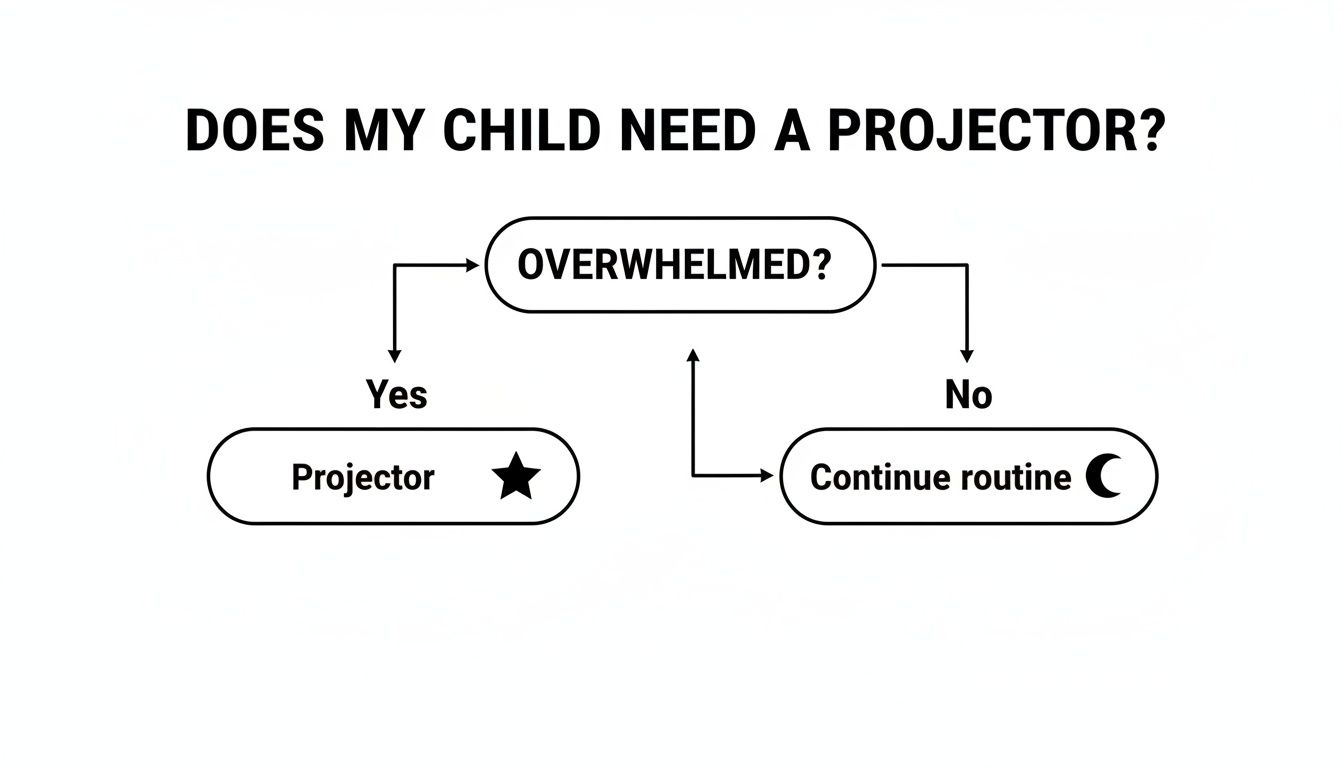
It’s a simple way to think it through: if bedtime feels like a battle against sensory overload, a projector is definitely worth considering.
Safety And Durability Considerations
Last but certainly not least, let's talk safety. Anything that lives in your child's bedroom needs to be built with their well-being as the top priority.
Here are the safety non-negotiables to look for:
- Low-Heat LED Bulbs: LEDs are the gold standard. They give off almost no heat, meaning the projector stays cool to the touch and is safe to leave on.
- Child-Safe Materials: Always check that the projector is made from non-toxic, BPA-free plastic. A solid build that can handle a few accidental knocks is also a good sign of quality.
- Cordless Options: A rechargeable, cordless model is a fantastic choice, especially for younger kids. It removes any risks tied to power cords and gives you more flexibility on where to place it.
By keeping these features in mind—from the visuals and sounds right down to the materials it's made from—you can confidently choose a projector that will become a trusted part of your child’s journey to a more peaceful night's sleep.
Creating a Successful Bedtime Routine with Your Projector
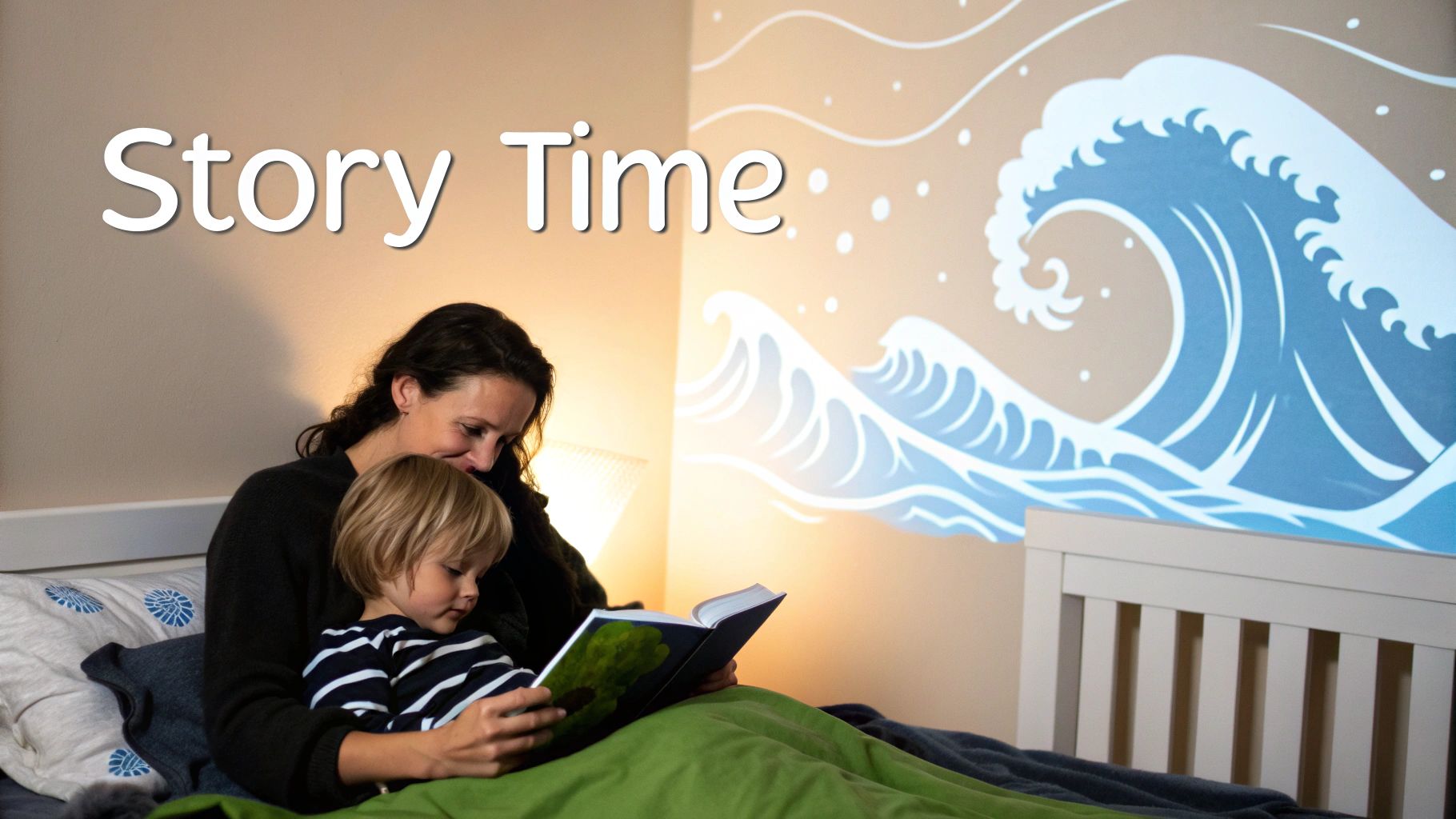
So, you’ve unboxed your new child's night light projector – that’s the easy part! The real magic begins when you weave it into your evening wind-down, turning it from a cool new gadget into a comforting and predictable ritual.
The whole point is to build a routine that consistently signals to your child’s brain and body that it’s time to rest. When the projector becomes a central part of this process, it creates a clear, gentle runway from a busy day to a quiet night.
Finding the Perfect Placement
Where you put the projector can completely change the experience. You’re aiming for an immersive, soothing atmosphere – a beautiful backdrop, not a distracting light show right in their face.
Here are a few tips to get it just right:
- Think Indirect: Never point the projector directly at your child’s bed or face. Aim it at a blank wall or the ceiling to create a wide, gentle display that fills the space without being intrusive.
- Create Some Distance: Popping the projector on a dresser or shelf across the room often works best. It gives the projection room to breathe, creating a more expansive and less intense visual field.
- Keep It Stable and Safe: Make sure it’s sitting on a sturdy surface where it can’t be easily knocked over, especially if you’re using a model with a cord.
The right placement transforms the entire room into a calming sensory space, wrapping your child in a visual hug of stars or gentle waves. This setup is the foundation for making the experience feel secure and predictable every night.
Weaving the Projector into Your Routine
Once you’ve found the perfect spot, it’s time for the projector to become a star player in your bedtime routine. And with routines, consistency is everything. Introducing it as a special part of a familiar sequence helps your child build positive, sleepy associations.
Why not create a "story time under the stars" ritual? Dim the main lights, switch on the projector, and read a favourite book together. This beautifully weaves the projector's calming visuals into an activity your child already loves, making it something they look forward to. Cuddling with a plush Palm Pals Australia toy or a warmable Snoopy can make this time even cosier.
If your child seems a bit hesitant about this new addition, introduce it slowly. Let them have a play with the colour settings or choose their favourite projection theme well before bedtime. Giving them a sense of control can ease any apprehension and help them bond with their new calming tool. For more ideas on structuring your evening, our guide to using a kids' routine chart has some fantastic strategies that pair perfectly with a sensory projector.
Remember, the goal is to make the projector a signal for calm. It’s the visual cue that says, "It’s time to slow down, get cosy, and prepare for a restful night’s sleep."
Using Timers to Transition to Sleep
One of the most practical features on any good sensory projector is the automatic timer. This little function is your best friend for promoting healthy sleep hygiene, because all the research points to a dark room being best for deep, restorative rest.
Try setting the timer to switch off about 20-30 minutes after your child usually drifts off. This gives them the comfort of the visuals as they fall asleep but ensures the room is properly dark during their deepest sleep cycles. This transition helps their brain produce melatonin effectively, which leads to better quality sleep and a much happier morning.
It makes the projector the perfect tool for the transition to sleep, not an all-night crutch.
Using Projectors in Calming Corners and Sensory Classrooms

While we often think of a child's night light projector as just a bedtime tool, its real magic extends well beyond the bedroom. These projectors are incredibly powerful when used in dedicated safe spaces like calming corners at home or in sensory classrooms, helping children self-regulate throughout the day.
A projector can instantly transform a small area into a peaceful retreat. For an overwhelmed child, the gentle, predictable motion of drifting stars or waves provides a visual anchor, helping them de-escalate and find their centre in a low-demand environment.
Creating the Ultimate Calming Corner
Think of the projector as the heart of a well-designed calming corner; it sets the entire tone for the space. When a child feels their emotions spiralling, this corner becomes their personal haven to reset their nervous system.
Imagine a space where the ceiling swirls with a gentle galaxy. This is the first layer of calm. From there, you can build a multi-sensory experience with other supportive tools.
- Complement with Comfort: Pair the soothing visuals with the deep pressure of a weighted animal toy or the gentle, rhythmic hug of a sensory swing.
- Add Tactile Elements: Keep a basket of Kaiko fidgets or popular Needohs nearby to give busy hands a quiet, repetitive task to focus on.
- Create a Safe Enclosure: Setting everything up inside a sensory tent is a fantastic way to block out distractions and make the projector’s immersive effect even more powerful.
This combination gives a child everything they need to self-soothe in a way that feels safe and controlled.
A Powerful Tool for the Sensory Classroom
Educators are also seeing the huge impact these projectors can have at school. A sensory classroom or resource room with a projector offers an essential regulation space for students who need a break from the busy, often overwhelming school environment.
During tricky transition times—like settling down after recess or preparing for quiet work—a projector can quickly lower the energy in the room, helping the whole class settle and refocus.
Research actually backs this up, showing that classrooms using these visual aids can see 28% calmer transitions. These tools are becoming vital for Australian educators. As an NDIS-accepted Melbourne store, we’ve found that 40% of our night light sales go directly to plan managers for use in therapeutic and educational settings.
If you’re interested in learning more about how sensory tools fit into a broader educational strategy, exploring resources on creating inclusive learning environments is a great next step. It’s all about helping every child feel seen and supported. By using projectors in these spaces, we’re not just decorating a room—we’re actively creating tools for emotional regulation and learning.
How to Use Your NDIS Funding to Buy a Projector
Figuring out NDIS funding can sometimes feel like you're trying to solve a puzzle, but getting your hands on essential sensory tools like a child's night light projector shouldn't be complicated. We're an NDIS-accepted provider here at The Sensory Poodle, and our goal is to make it as simple as possible to use your funding for the tools that bring calm into your home.
So, how does it work? A night light projector usually fits into the NDIS category of Low-Cost Assistive Technology for Sensory Support. If your child’s NDIS goals include things like improving sleep, learning to self-regulate, or creating a safe sensory space, then a projector is almost always a great fit.
In fact, these projectors have become recognised as essential aids. Recent NDIS data shows that claims for sleep-support tools jumped by 32% in 2024. In New South Wales and Victoria alone, 42,000 autistic children under 12 received plan-funded night lights or projectors in 2024, which corresponded with a 22% improvement in parent-reported sleep quality. You can dive deeper into these trends by exploring insights on the growth of the Australian digital projector market.
It All Depends on How Your Plan is Managed
The steps to buy your projector will look a little different depending on how your NDIS plan is managed. We've set things up to be easy for everyone, no matter what your plan looks like.
Here's a quick rundown of your options:
- Self-Managed: This is the most direct route. You have the flexibility to buy the projector from our website just like any other purchase. Afterwards, you simply claim the expense back from your NDIS funds using the MyPlace portal. Easy.
- Plan-Managed: We'll sort this out directly with your plan manager. All you need to do is add the items to your cart, choose 'NDIS Plan Managed' at checkout, and pop in the participant's details. We send the invoice straight to your plan manager to handle the payment.
- NDIA-Managed (Agency-Managed): For those managed directly by the NDIA, we can put together a quote for you. You can submit this to the NDIA for approval, and as soon as it's given the green light, we'll get your projector on its way.
Our Simple Process for Plan-Managed Orders
A big part of our community is plan-managed, so we've made sure our NDIS ordering process is as smooth as it gets.
Our whole aim is to get rid of any buying hurdles. We handle the invoicing directly with your plan manager, which means we take that admin work off your plate. You can just focus on what matters most—supporting your child.
It’s a quick and efficient system designed to get you what you need, fast:
- Step 1: Have a look through our collection of night lights and other fantastic sensory toys in Australia, then add your picks to the cart.
- Step 2: When you get to the checkout, fill in your shipping details and choose the 'NDIS Plan Managed' payment option.
- Step 3: You'll be asked for the NDIS participant's details—just their name, NDIS number, and your plan manager’s email address.
- Step 4: We'll take it from there! An invoice zips over to your plan manager. As soon as they pay it, we pack up your order and ship it straight from our Melbourne warehouse.
We've designed this process to ensure that getting vital tools like a child's night light projector is a simple, completely stress-free experience for your family.
Got Questions? We’ve Got Answers
Stepping into the world of sensory tools can feel a little overwhelming, and it's natural to have a few questions. We get it. Here are some of the most common things parents and carers ask us about our child's night light projectors.
"Won't a Projector Just Keep My Child Awake?"
This is probably the number one question we hear, and it's a great one! It’s all about how you use it. A projector isn't meant to be an all-night disco ball; it’s a gentle cue for the brain to start winding down for sleep.
Here’s how to make sure it encourages sleep, not stimulation:
- Make friends with the timer: Most good projectors have one. Set it to switch off automatically once you know your child is sound asleep. This allows the room to become properly dark, which is crucial for the body to get that deep, restorative rest.
- Pick calming colours: Think deep, dreamy blues or soft, gentle reds. These hues are far less likely to mess with the body's natural melatonin production and sleep cycle.
- Dim it right down: You’re aiming for a soft, ambient glow, not a spotlight. Always use the dimmest setting that still provides that sense of comfort and magic.
"Are These Projectors Actually Safe to Leave in My Child's Room?"
Absolutely, provided you choose a projector that’s been designed with kids in mind. When it comes to anything in a child’s personal space, safety isn’t just a feature—it’s everything.
Here’s what to look for to ensure it's a safe choice:
- Cool-touch LED bulbs: This is a non-negotiable. LEDs don't get hot, so there's no risk of little hands getting burned if they touch the device, even after it's been running for a while.
- Tough, non-toxic materials: Kids can be rough! A well-made projector should be built from sturdy, child-safe plastics that can handle the odd bump or tumble.
- Cord-free is worry-free: For younger children especially, a rechargeable, cordless projector is often the best bet. It completely removes any potential hazards from dangling power cords.
We've done the hard work for you—every projector we stock at The Sensory Poodle has been hand-picked to meet these strict safety standards, so you can rest easy.
"What’s the Big Deal? Isn’t It Just a Fancier, More Expensive Night Light?"
I can see why you'd think that! While a cheap projector might toss a few stars onto the ceiling, a true sensory projector is a whole different beast. It's less of a toy and more of a therapeutic tool, designed from the ground up to support a neurodiverse child's needs.
The real difference is in the details that matter:
- Fine-tuned control: A sensory projector gives you the power to adjust the brightness, the speed of the motion, and the specific colours. This allows you to create a "just right" sensory experience that calms, rather than overstimulates.
- More than just light: Many of our models come with built-in soundscapes, like white noise or gentle nature sounds. This adds another layer of soothing sensory input to help quiet a busy mind.
- Built to last: These projectors are designed for daily use as a reliable support tool. They're robust, safe, and made with purpose, not just to be a passing novelty.
Ready to turn bedtime from a battle into a calm, comforting ritual? At The Sensory Poodle, we’ve carefully selected a range of the best sensory night lights and projectors out there—all designed to help with emotional regulation and a peaceful night's sleep.
Find the perfect child's night light projector at Sensory Poodle